
I kneel beside an aquamarine pool of glacial meltwater, struggling to catch my breath in the thin air. It’s a constant battle at this extreme elevation in Peru’s Cordillera Vilcanota, where boulder fields and ice dominate the landscape.
Wheezing, I watch a figure navigating the scree. Every now and then, she bends down and grabs a rock, flips it over, examines the ground beneath and carefully replaces it. Again and again she does this – flip, check, replace, walk; flip, check, replace, walk. This is Emma Steigerwald, a PhD student from the University of California, and she’s looking for frogs.
- Scientists discover new frog in the Amazon’s flooded forests
- It’s one of the most destructive, dangerous and deadly animals on earth – meet the highly toxic ‘toadzilla’
It’s the first week of our two-month expedition into these remote mountains. Accompanying Emma and I are Gumercindo Crispin, a Quechua translator and horse driver, and Michell Oruri, a biologist from Cusco. We are the only people for several days’ walk in any direction.
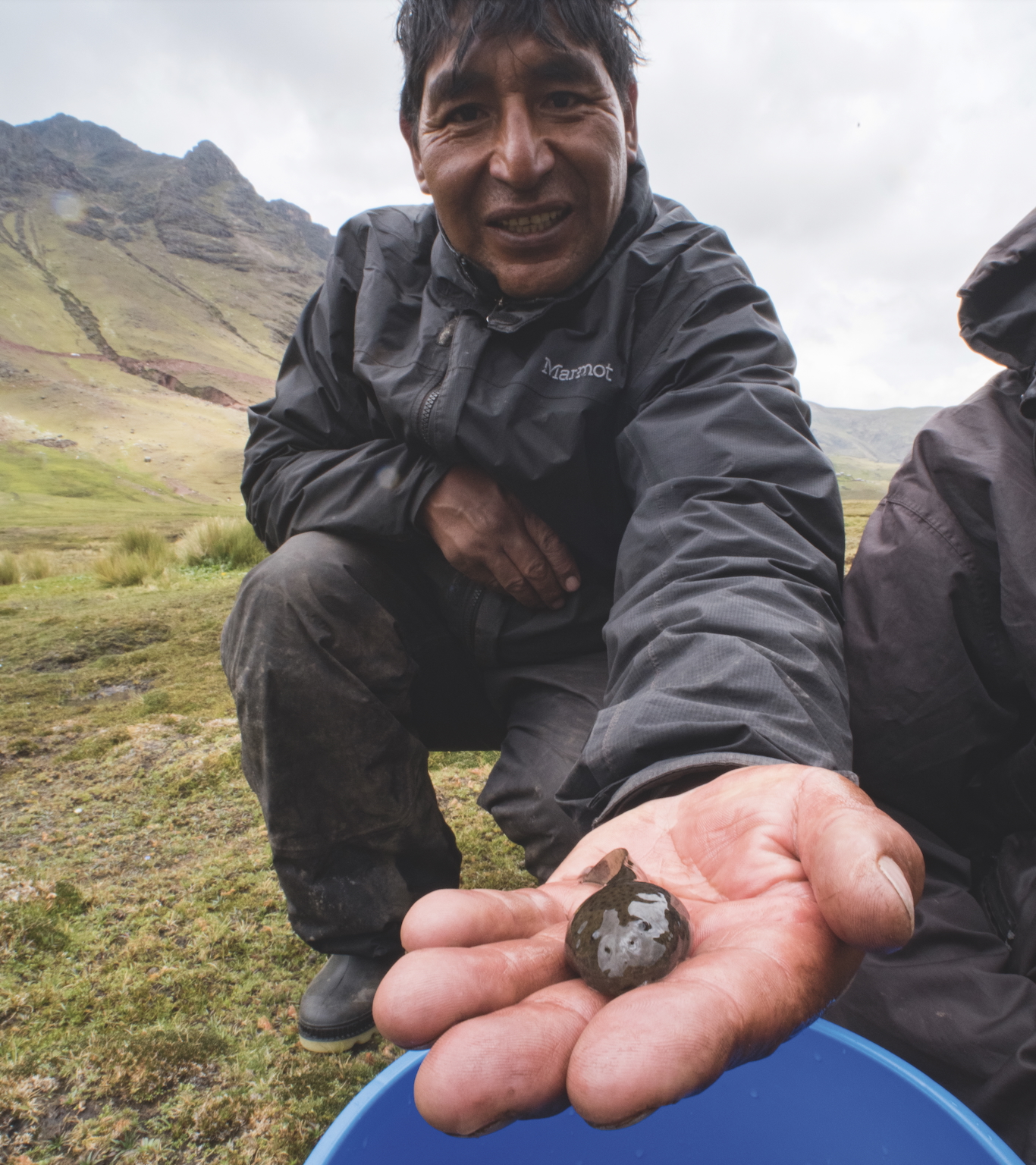
I take one last heaving breath, insufficient and unsatisfying, then return to assisting Emma. I turn over another six or seven rocks – and then, there it is – a marbled four-eyed frog (Pleurodema marmoratum). It’s a beige, blotchy creature, small enough to sit comfortably on my palm, along with half a dozen of its brethren.
- Yosemite toads are entering their winter burrows healthy – and emerging in spring with deadly infections
- Why do some frogs have five legs?
This unassuming little frog is a vanguard of amphibian-kind. Along with the marbled water frog (Telmatobius marmoratus), it is found higher than any other amphibian worldwide. Our small team is attempting to track these frogs, along with the warty toad (Rhinella spinulosa), to the very apex of their range: 5,400m above sea level in the Peruvian Andes.
A changing landscape
Had we been standing in this particular mountain pass a century ago, we would have found ourselves perched on a deep sheet of ice. Back then, an enormous glacier filled the valley, part of the extraordinary network of tropical glaciers for which Peru is renowned.
Yet the ice in the cordillera has been retreating for decades, and by 1980, an ice-free passage had emerged. It’s a bizarre, moon-like terrain, flanked by the still-imposing remnants of glaciers that persist along the valley edges.
“It’s kind of intimidating, and remarkable, and frightening, to think how recently ice was present – and the drastic change this represents,” says Emma. “As you go higher, you find intrepid species colonising this new landscape.”
As the ice melted over the decades, both species of frog crept upwards, gradually expanding their ranges on either side of the mountains. Eventually, they met in the high pass, where the newly ice-free corridor now reconnected habitats divided by the glacier.
It was a convergence of long-lost relatives. The two species, living on opposite sides of the mountain range, had not been apart long enough to evolve into separate species, yet their populations had become genetically distinct.
Natural laboratory
Other amphibians are on their way up. The warty toad is currently the next highest, and behind it, several more species appear to be climbing. Such movement is what makes Vilcanota a unique natural laboratory – one that Emma, a herpetologist and population geneticist, could not turn down the chance to explore. She had a golden opportunity to research the genetic diversity of frogs at the very front lines of a new frontier.
Emma also wanted to find out if the elevation could alter the dynamic of the deadly chytrid fungus, which affects amphibians across the globe. The fungus has already caused mass die-offs in Peru, particularly in Manu National Park and the southern Andes, but conditions on these high slopes are nearly as inhospitable to fungi as they are to frogs. How might infection look in this new world?
With slow and deliberate movements, we quietly continue our mission. Every time we stumble across a frog, we take a small genetic sample, swab for chytrid, collect data on health, and then release it. The specimen I’ve just found is my third of the day; the others have located several more between them. Emma seems to have a knack for finding their hidey-holes, though, with a personal tally of half a dozen.
- “It creates tiny holes all over the skin, allowing deadly bacteria to invade the internal organs, causing septicaemia and death.”
- “It will die unless its father can find a better place for it.” Tiny poison dart frogs race against time to save their offspring
For Emma to accurately map the genetics, we ideally need to find 15 specimens of each species per half kilometre of the roughly 16km de-glaciated pass, and per 3km in the less rugged areas downslope. In some stretches, we’re only searching for a few hours before locating all the amphibians we need, sometimes stumbling across multiple frogs huddled together under a single stone.
In others, we search for days and still don’t find enough. Our gloves quickly become worn at the fingertips from lifting tens of thousands of rocks.
Despite our good intentions, the amphibians are not willing participants. The water frogs are so slippery that attempting to catch one is like trying to grasp a wet and kicking bar of soap, while struggling, squirming toads are equally tricky to grapple with. “You don’t feel like you need to be delicate with them,” says Emma. “It’s quite the opposite – because they are so strong, they twist and push.”
The only way into the amphibians’ habitat is on foot. We’ve already been walking for several days, our food and equipment loaded onto four packhorses. We plod behind them, battling altitude sickness to remain in the wilderness for weeks at a time. We’re swaddled in thermal layers, puffer jackets and thick wool socks, yet the cold permeates everything.
Vilcanota experiences considerable variation in the weather, which shifts between baking sun, storms and blizzards, punctuated by bone-chillingl freezing nights. Each morning, we emerge from our tents to frost or snow, which melts as the sun warms the slopes.
Animal adaptations
To survive, animals adapt. Four-eyed frogs, incredibly, can withstand freezing and thawing, while water frogs hide at the bottom of pools and streams, where temperatures are more stable. On several occasions, we see warty toads clambering over the snow, seemingly unbothered by the cold beneath their feet.
- "Once they near emergence, the female's thin skin bulges and pulsates with the struggles of the impatient offspring within…"
- It's called a chicken, sounds like a chicken, tastes like a chicken and raises its young like a chicken – but it definitely isn't a chicken…
The briefest of warm spells brings Liolaemus lizards out to bask and feed. Like our frogs, these lizards are pioneers, and count among the highest-living reptiles in the world. A little frost doesn’t scare them.
Despite the hardships, it’s impossible not to be awed by our surroundings. We spend days traversing multi-hued stony ridges that eventually give way to a type of high-elevation grassland known as ‘puna’. Up here, I’m struck by the quiet.
There’s no chirping of insects and precious little of the birdsong that pervades the lower valleys. Instead, the silence is broken only by the whistling wind and rolling rumble of distant rockslides. Beyond the puna, at the absolute limits of amphibian existence, there’s nothing but fields of glacier-crushed rock, where even plants are rare.
As we walk, we stumble across unique and bizarre environments that few people will know of, such as the ‘stone forest’, where jagged rock spires jut from the landscape like cathedral-sized termite mounds. We spend several days navigating these labyrinthine passes, coaxing the spooked horses through narrow gorges before emerging on the other side.
We find other species eking out a living alongside the frogs. There are enormous white cacti resembling car-sized brain corals; viscachas – energetic, rabbit-like rodents – bouncing among the boulders, and slow-moving, ghostly tarantulas.
But nowhere is as full of life as the bofedales – spongy peatbogs fed by glacial meltwater and packed with cushion plants. These oases are a magnet for wildlife. Herds of vicuña, wild relatives of llamas, visit to drink and feed, while glacier finches – one of the only birds to nest on glaciers – flit between plants, plucking seeds and insects.
- Scientists recreated the effects of dating apps on frogs. Here’s what happened next
- "With the flex of a muscle, it can produce an arsenal of sharp, curved claws that snap out of its toes like switchblades" 11 weirdest, bizarrest frogs on the planet
Frogs also breed in the bofedales and the streams that flow from them. Stable bofedales are particularly critical for the marbled water frog, which is wholly aquatic. It remains in the water even after its tadpole stage, which lasts more than a year.
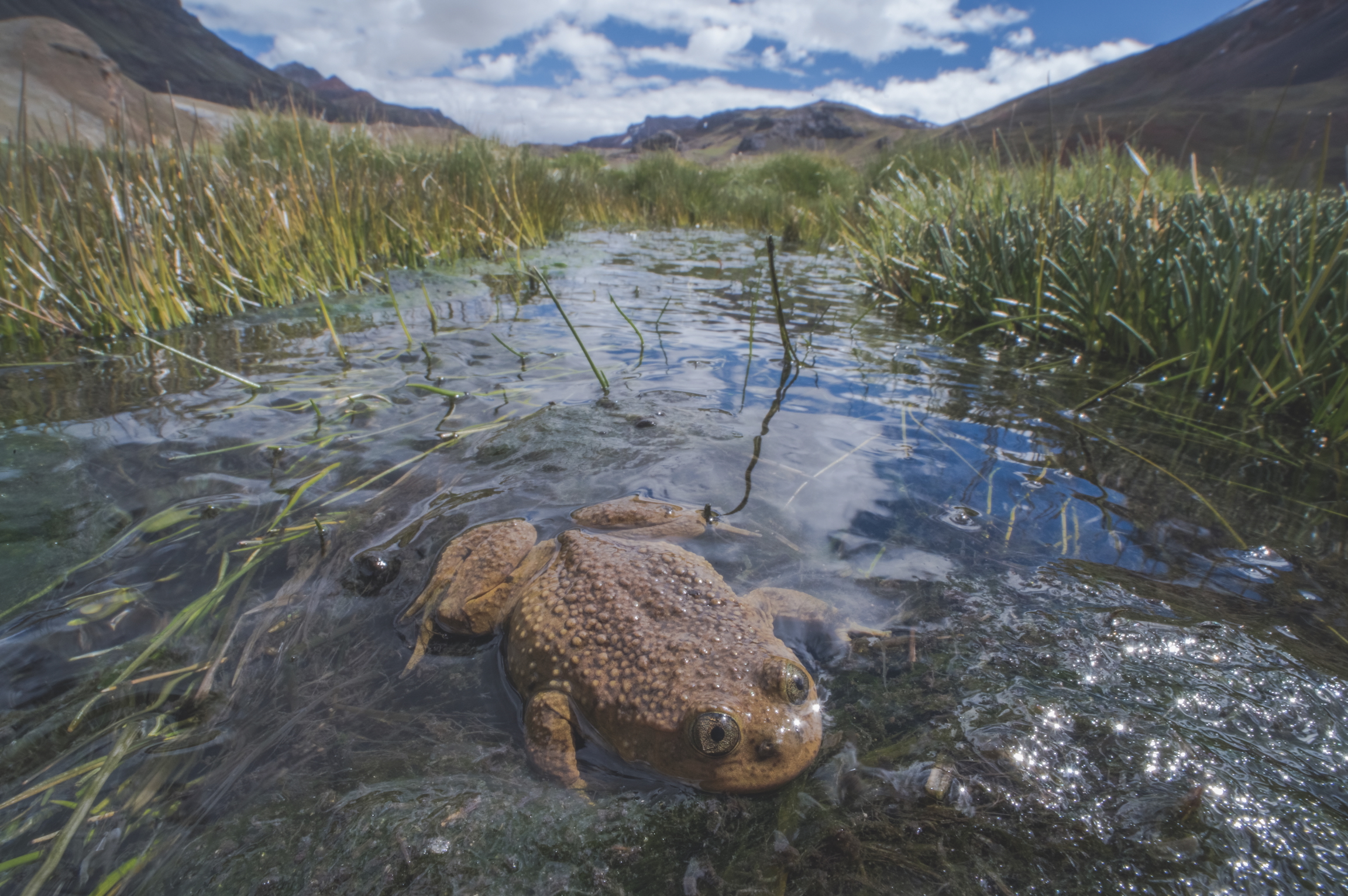
It’s a mystery how the species made its way to these isolated wetlands – it’s thought via subterranean seeps and flooding events. Water frogs have the slowest metabolism of any frog genus, likely an adaptation to the elevation and scarcity of food.
After spending weeks in tents, reaching a village is always a welcome change. We are often offered local potatoes, which taste more delicious and distinct than you could ever imagine, varying from sweet to earthy.
Changing perceptions
Potato fields are frequented by warty toads, which brings them into contact with people – and it’s not a happy coexistence. The Incas saw toads as benevolent, creating statues and even naming a constellation in their honour.
But across the centuries, perceptions have shifted, and Quechuan communities now fear the toads. They believe the amphibians feed on blood, pursuing menstruating women in particular, and often kill them on sight.
Such beliefs are brought into sharp focus when we pass through one village. A man stops me for questioning – which is understandable, given that most outsiders are linked with exploitative or illegal gold mining. Seeking to diffuse the situation, I show him the toad I’m carrying. But rather than alleviate the tension, I scare him half to death.
- These baby animals are swallowed by their fathers and ‘vomited’ out when they’re fully formed
- It looks like a tomato, has a very weird tongue, and can produce some extremely nasty secretions
Aiming to change perceptions, Emma, together with collaborators in the USA and Peru, has developed an educational comic book, which we present to schools as we pass through. We also bring amphibians into classroom settings, which is hugely effective.
Despite living surrounded by these animals, the children never have any close interaction with them. Initially, they’re terrified of our charges, but fear soon shifts to interest. After one of our presentations, a horde of children even runs around finding toads, herding them towards us.
They’re still too hesitant to pick them up, but at least they’ve become confident enough to approach.
In total, we spend two months trekking through the Cordillera. We walk more than 400km, locate thousands of frogs and distribute 750 comic books.
Returning to California after the expedition, Emma analyses all the samples and swabs taken from the slopes. She discovers that the frogs’ new frontier is no safe haven from chytrid: the fungus still appears to affect frog body size, though altitude may constrain the intensity of infection.
Emma also discovers several genetic differences that may help the frogs survive the cold and the low-oxygen conditions at high altitude, helping them flourish where most cannot.
- A thousand toads mysteriously exploded in 2005 – and the explanation was way stranger than anyone expected
- “This huge ‘cloud’ seemed to come out of nowhere. Suddenly frogs started to fall from the sky. I thought a plane carrying frogs had exploded..."
With the looming threat of climate change, Vilcanota’s frogs and toads are stuck in a precarious position. As glaciers continue to melt, the question remains whether there will be enough water to sustain life at these elevations. The slightest shift in environmental conditions could render the Cordillera inhospitable, and unravel decades of colonisation.
Yet so far, these plucky little amphibians are proving resilient, even defiant, in the face of a rapidly changing world. With luck, they will always have a home among the peaks and valleys of these remote mountains.
Top image: marbled four-eyed frogs travel up these remote mountains to find mates, one jump at a time. Credit: Anton Sorokin
Discover more wildlife stories from around the world:
- 12 weirdest body parts, including fake penises, creepy extra-long fingers – and a moth with a remarkable 30cm long tongue...
- Betrayal, romance and power: The real-life soap opera of Yellowstone's most famous wolves that turned scientists' thinking upside down
- A tree that grows underground? Discover the trees that grow trunks, fruit and even flowers below the earth


